What are cookies?
Cookies are small pieces of data that are stored on a visitor's device when they visit a website. They are often used to remember information about the visitor's preferences and browsing history and can help website owners to provide a more personalised experience for their visitors. For example, cookies can be used to remember a visitor's login information or to keep track of items in a shopping cart. They can also be used to collect data about a visitor's browsing habits, which can be used for a variety of purposes such as targeted advertising.
What your Cookie Consent notice should have
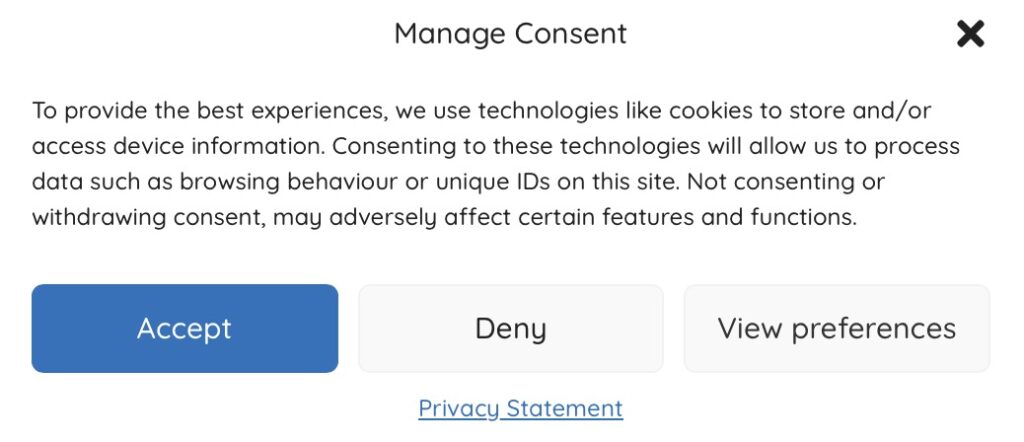
Just having 'Accept and OK, are not ok, you need a 'deny' option so that people have the choice to turn them off, such as the below from the Complianz | GDPR/CCPA Cookie Consent plugin in WordPress:
The law
The cookie consent law is a set of regulations that require websites to obtain consent from visitors before they can store or retrieve any information on a visitor's computer or device. This law is intended to protect the privacy of website visitors and to give them control over their personal data. It typically applies to cookies, which are small pieces of data that are stored on a visitor's device when they visit a website.
European Union (EU)
The General Data Protection Regulation (GDPR) requires explicit consent for cookies and other tracking technologies. This applies to all EU member states and any website targeting EU users.
United Kingdom (UK)
Following Brexit, the UK adopted its own version of GDPR, which includes similar cookie consent requirements.
Canada
Under the Personal Information Protection and Electronic Documents Act (PIPEDA), websites must obtain consent for collecting and using personal information, which can include cookies.
Australia
The Privacy Act 1988 and the Australian Privacy Principles require websites to inform users about the collection of personal information, which can extend to cookies.
Brazil
The General Data Protection Law (LGPD) requires clear and explicit consent for the use of cookies and other tracking technologies.
South Korea: The Personal Information Protection Act (PIPA) mandates consent for the collection and use of cookies.
Japan
The Act on the Protection of Personal Information (APPI) requires websites to disclose the use of cookies and obtain user consent.
South Africa
The Protection of Personal Information Act (POPIA) requires websites to obtain consent for the use of cookies and other tracking technologies.
United States (specific states)
While there is no federal law requiring cookie consent, certain states like California (under the California Consumer Privacy Act - CCPA) have regulations that can be interpreted to require clear communication about the use of cookies.
What counties does the cookie consent law affect?
The cookie consent law applies to any website that is accessible to users in countries that have enacted such regulations. This currently includes most countries in the European Union, as well as other countries such as Brazil and Canada. Because cookies can be accessed from any device that is connected to the internet, the law applies to all websites, regardless of where they are located or who operates them. As a result, website owners around the world may be required to comply with the cookie consent law if they have visitors from countries that have enacted such regulations.
How to alert website users that your site uses cookies
There are a few different ways that website owners can alert their users that their site uses cookies. The most common approach is to include a banner or pop-up message on the site that informs users about the use of cookies and provides a link to a privacy policy that explains how the cookies are used. This banner or message should be displayed prominently and should be easy for users to understand.
Another approach is to include information about the use of cookies in the website's privacy policy. The privacy policy should explain what cookies are, why they are used, and how they are managed. It should also provide details about how users can manage their cookie preferences, such as by adjusting their browser settings.
Overall, the key is to make sure that users are aware of the use of cookies on your site and are given the opportunity to learn more about how they are used and how they can manage their preferences. This can help to build trust and ensure that your site is compliant with the cookie consent law.
What we do for our websites
We add a banner and privacy policy page to all the websites we design. Our websites are hosted in the UK and adhere to UK data protection regulations.
Does having a Cookie Consent notice affect my rankings in Google?
Google does not specifically mark down websites for not having a cookie consent banner. However, there are some indirect ways that a lack of a cookie consent banner could potentially affect a website's search ranking:
User Experience (UX)
Google places a high emphasis on user experience. If a website without a cookie consent banner leads to poor user experience, such as users feeling unsafe or annoyed, this could result in higher bounce rates or lower dwell times, which might negatively impact rankings.
Compliance with Laws and Regulations
While Google itself doesn’t penalize for the absence of a cookie consent banner, failing to comply with laws like the GDPR (General Data Protection Regulation) or the CCPA (California Consumer Privacy Act) could lead to legal consequences, which could indirectly affect a website’s reputation and trustworthiness. Websites that face legal challenges or penalties might also experience negative effects on their search rankings.
Trust Signals
Google considers various trust signals in its ranking algorithms. Websites that comply with legal requirements and provide a clear, transparent user experience are more likely to be trusted. Not having a cookie consent banner when it is legally required could undermine user trust, potentially leading to lower engagement metrics that Google might interpret as lower site quality.
Content and Advertisements
Google’s policies around certain types of content and advertisements might be affected by whether a website complies with relevant privacy laws. For example, Google AdSense and other advertising platforms require compliance with GDPR and CCPA, and non-compliance could affect ad revenue and potentially site rankings indirectly.
To sum up, while the absence of a cookie consent banner itself isn't a direct ranking factor, the consequences of not having one—such as poor user experience, legal penalties, reduced trust, and non-compliance with ad policies—can indirectly impact a website's search ranking.